

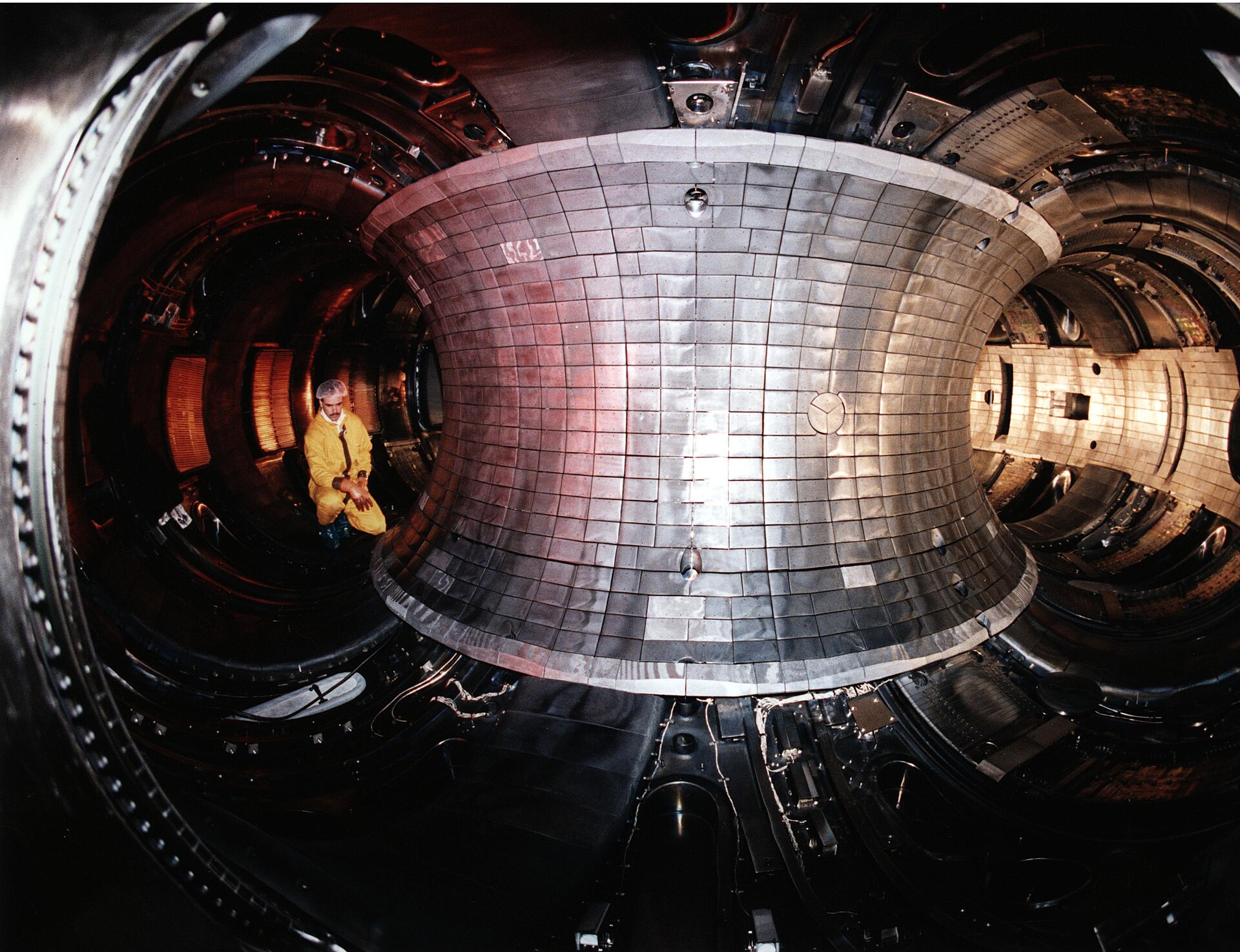
Fusion has been thirty years away for roughly sixty years — the oldest joke in energy. Something has shifted, though: experiments are hitting their milestones, private companies have raised billions, and the conversation, tracked by bodies such as the IAEA, has moved from whether fusion works to who will commercialise it first and on what design.
The physics was never in doubt — the Sun is the proof of concept. The challenge is engineering a star in a bottle: heating hydrogen isotopes past a hundred million degrees, holding the resulting plasma steady with magnetic fields, and extracting more energy than the whole apparatus consumes.
Magnets Changed the Arithmetic
The pivotal technology is unglamorous: tape. High-temperature superconducting tape, wound into magnets far stronger than the previous generation, shrinks a tokamak dramatically — and cost falls with size. A design that needed a machine the scale of a cathedral can now fit in a warehouse, with the same physics output.
That compactness is why startups multiplied. When a credible reactor fits a venture-scale budget, iteration speeds up: build, break, redesign. The large international projects still matter — they test scale and integration — but the field’s centre of gravity has visibly shifted toward speed.
The Milestones That Count
Scientific breakeven at the fuel level has now been demonstrated repeatedly in laser fusion, while magnetic experiments have set records in sustained plasma performance and triple product — the combined score of temperature, density and confinement time. Each record is a checkpoint on a known road, not a lottery win.
The next checkpoints are industrial: a machine that produces net electricity, materials that survive years of neutron bombardment, and a tritium fuel cycle that breeds its own fuel. None violates physics; all are engineering of the most demanding kind, which in fusion is another way of saying “the work itself”.
Money, Talent and the New Race
Private investment in fusion has passed the point where it can be dismissed as speculative garnish, and the talent has followed — plasma physicists now share lab space with magnet engineers, roboticists and people who build supply chains for a living. Governments have responded with milestone-based funding programmes that pay for results.
Geography is part of the race. The United States, Europe, China and Japan all host serious programmes, public and private. Fusion’s strategic prize — energy-dense, fuel-abundant, geography-independent power — is understood in every capital, and the export industry it could seed is understood too.
Not all designs chase the same shape. Alongside the tokamak mainstream sit stellarators with their baroque twisted magnets, laser-driven inertial systems, and compact concepts using liquid metal walls — a portfolio approach the field’s elders, raised on a single flagship, find both alarming and healthy.
What Fusion Would Actually Change
A working fusion plant offers something neither fossil fuels nor renewables quite provide: dense, dispatchable, carbon-free power from seawater-derived fuel, sited almost anywhere. It would not replace wind and solar — those are cheap and getting cheaper — but it could anchor grids that renewables strain to serve alone, and power the industries that are hardest to electrify.
The sober timeline still runs through the 2030s for first-of-a-kind plants and beyond for fleets. Fusion’s contribution to the climate fight this century depends on how fast the first machines teach their lessons. The field’s new realism about that is, paradoxically, the strongest sign it has grown up.
The Wider Picture
The deeper story is one of instrumentation. Again and again in modern science, the breakthrough was not a new theory but a new way of seeing — a sensor, a telescope, an array — that turned an argument into a measurement. Fields that invest in their instruments inherit the future; the discoveries arrive as if on schedule.
Fusion spent decades as a promise. It is becoming a programme — with magnets, milestones and deadlines that can actually be missed, which is what real deadlines are for. The star in the machine is not lit yet, but for the first time the wiring is visibly being installed.
Read more in our Wedding Planning section, and follow the day’s coverage on our homepage.
