

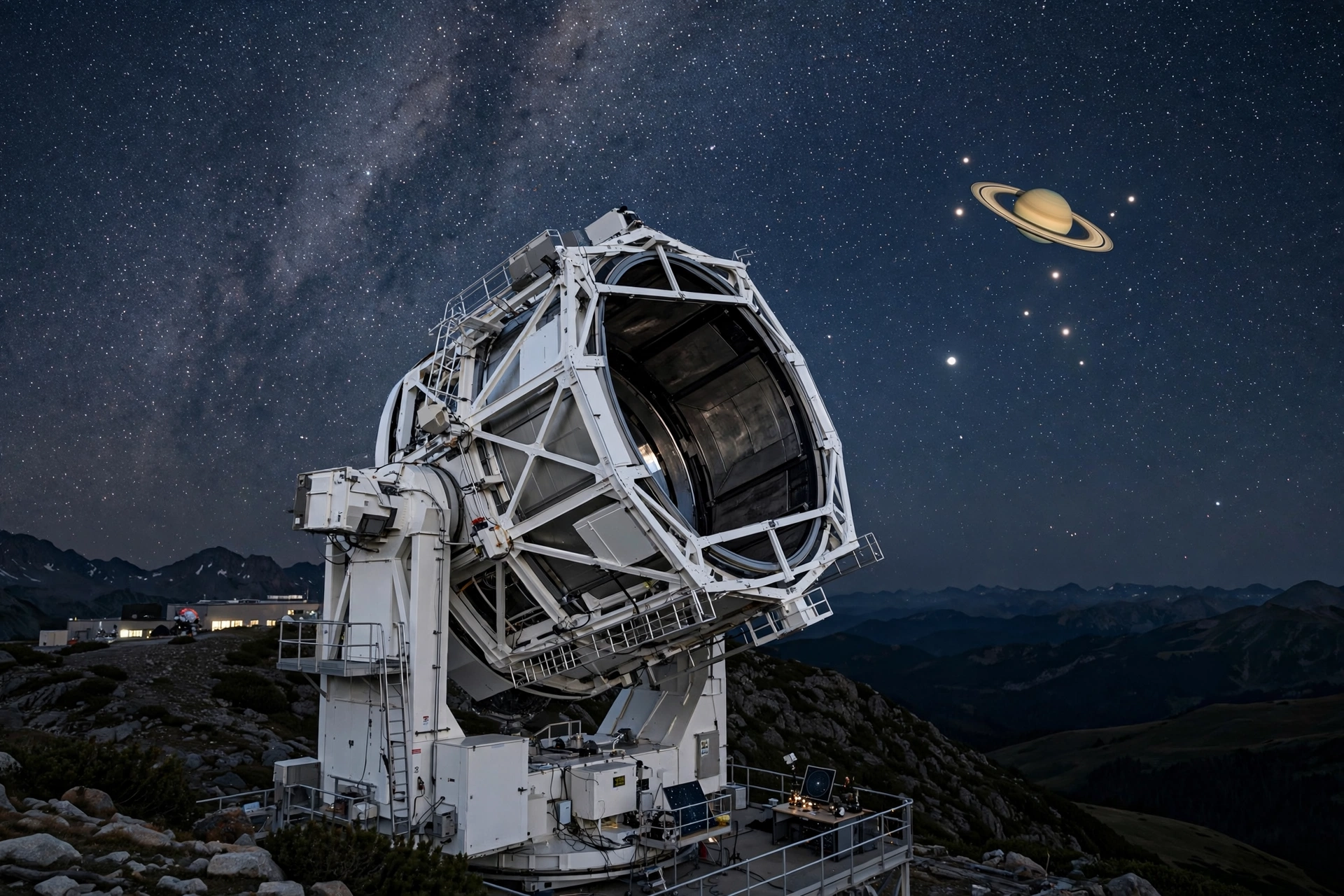
Here is a story to read with a cup of tea when the seating charts and supplier emails can wait five minutes: Saturn, the planet of rings and romantic skywatching, now officially has 274 moons. Astronomers have confirmed 128 new ones, taking the total from 146 to a number larger than all the other planets’ moons put together. Nobody is suggesting you name your tables after them — although, honestly, 274 moons would solve the table-naming problem for even the largest wedding — but as a piece of gentle, good-news science, it is hard to beat.
What Was Discovered, Simply Put
The new moons are not grand, glowing worlds. They are tiny — most only a few kilometres across — and they live far out from Saturn’s beautiful rings, wandering on tilted orbits. Many travel backwards around the planet, which tells scientists they were probably captured long ago rather than formed with Saturn, and many appear to be pieces of larger moons that broke apart after collisions. Think of them less as 128 new moons arriving, and more as 128 members of Saturn’s extended family finally being introduced by name at a very large reunion.
The discoveries have been recognised by the International Astronomical Union, which is the organisation that keeps the official lists, so 274 is now the number that books and documentaries will use.
How Do You Even Find Something That Small?
With patience, mostly. A team using the Canada-France-Hawaii Telescope, on the mountain of Mauna Kea in Hawaii, gathered deep photographs of the space around Saturn over several years. Researchers including Dr Edward Ashton, from the University of British Columbia, then used a technique called shift and stack: lots of images are shifted slightly, to follow a moon’s slow movement, and layered on top of each other, so a speck of light too faint to see in any single photo slowly becomes visible. The International Astronomical Union’s recognition followed only after each moon’s orbit had been checked and confirmed.
There is something rather lovely about the method. Nothing about it is instant. It rewards people who keep looking at the same patch of sky, carefully, for years — a quality that anyone who has planned a wedding over many months will recognise. Good things, assembled from a hundred small, patient steps.
Why It Is a Nice Story, Not Just a Big Number
Partly, it is the romance of it. Saturn has always been the planet people point telescopes at on clear nights, the one with the rings that look almost too perfect to be real. Knowing it is accompanied by 274 moons — a whole crowd of tiny companions, some of them fragments travelling together in families — makes the night sky feel a little more companionable. If dress hunting has you in a browsing mood anyway, our guide to wedding dresses for 2026 and the bridal styles defining the year is a very different, much more earthly kind of catalogue to get lost in.
Scientists, of course, want more than romance from the data, and they will get it. Families of moon fragments help researchers work out when old collisions happened and how planets collect the material around them. A census this complete makes those calculations far more reliable. But there is no rule that says a discovery cannot be useful and delightful at the same time.
A Few of the New Moons Will Get Names
One charming detail remains. Saturn’s distant irregular moons are traditionally named after figures from Inuit, Norse and Gallic mythology, so somewhere ahead there are 128 naming decisions to be made, drawn from some of the world’s oldest story collections. It will take time, and the names will arrive gradually rather than in one romantic list. Still, it means the extended family will not stay as catalogue numbers forever: each tiny fragment will eventually carry a name with a story of its own, which feels exactly right for moons.
The Takeaway for Your Coffee Break
Saturn: 274 moons, officially. Found slowly, confirmed carefully, and announced all at once. If you are in the middle of planning season, consider this your reminder that the universe is still quietly adding to its guest list — and that, unlike yours, Saturn’s extra 128 guests require no catering, no chairs and no plus-one negotiations at all.
